 EN
Topic: Copper vs aluminium busbar processing · tooling · springback · clearance
Brand focus: LT / LTMC 303U-3-C · 503U-3-C · 803U-3-C
Audience: Australian switchboard builders and panel shops
Quick answer
The same hydraulic 3-in-1 busbar machine (for example the LT 303U-3-C / 503U-3-C / 803U-3-C) can process copper and aluminium when force, die clearance, blade condition, bend radius, and clamp pressure match the material grade and temper. Australian switchboard builders and panel shops often run both materials in the same cell — do not assume a copper-approved setup will release the same angle, burr height, or hole quality on aluminium. Change material → re-check clearance, the springback table, and first-article samples before the bars go into an AS/NZS 61439 assembly.
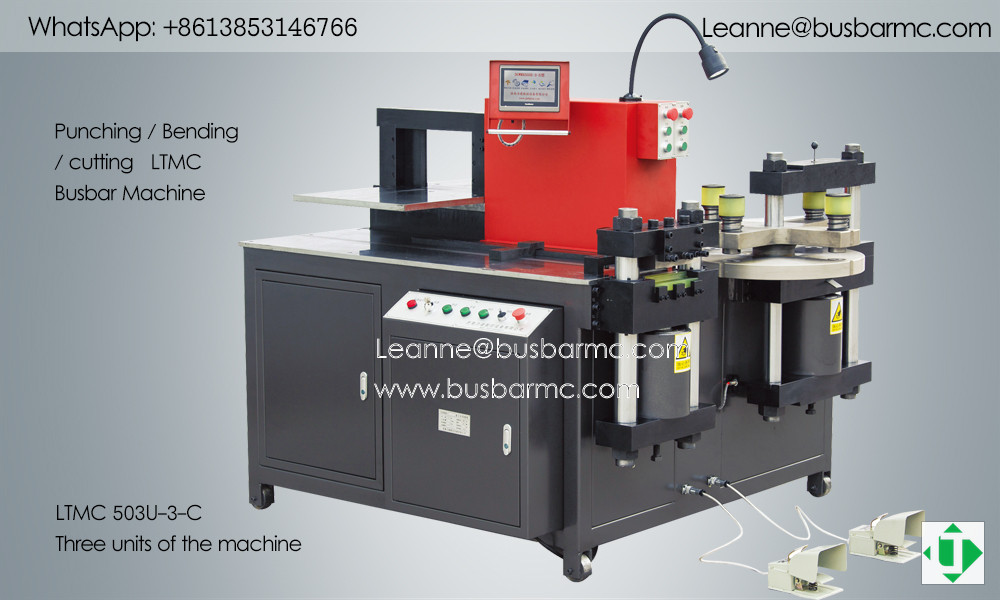
LTMC 503U-3-C three-station busbar machine overview (LT / LTMC)
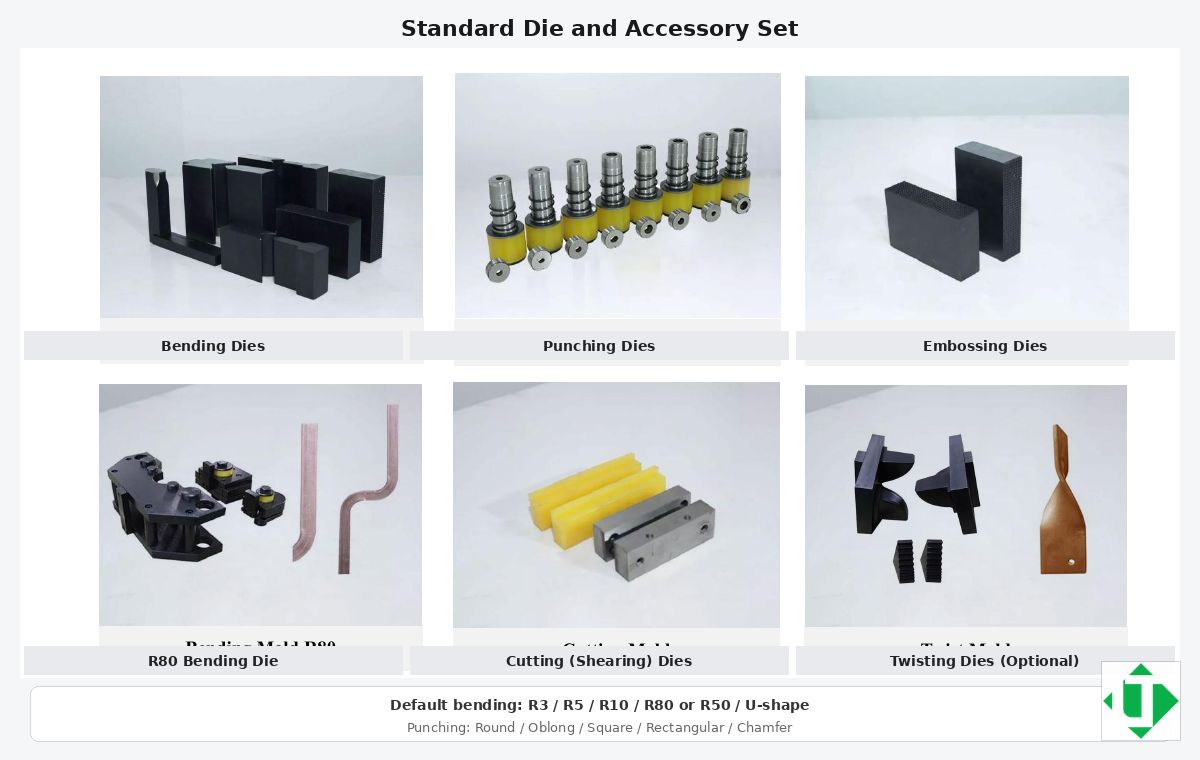
Standard die and accessory set with English labels
Why material choice changes the machine setup
| Factor | Copper typical effect | Aluminium typical effect |
|---|---|---|
| Conductivity / mass | Higher conductivity; denser bar | Lower mass and often lower material cost |
| Punching load | Baseline for die tonnage | Soft grades may mark easier; hard alloys still need force margin |
| Shear edge | Watch burr + blade wear | Watch clamp marks and local deformation |
| Bend springback | Baseline springback table | Usually larger compensation and larger min inside radius |
| Surface | Scratches still matter for contact faces | Oxide + soft surface → protect films / pad carefully |
Selecting copper vs aluminium drives tonnage margin, die clearance, blade life, and surface care—not only “which metal is cheaper.”
Punching: clearance and hole quality
Punch quality = die alignment + clearance + stripper + enough force for thickness × hole diameter.
- Keep separate clearance notes for Cu vs Al on the same turret.
- After a material switch, inspect the first holes for burr, tear, and ovality before releasing the batch.
- Published punch ranges (public tables): 303 Φ4.3–Φ25 · 503 Φ4.3–Φ30 · 803 Φ4.3–Φ34.
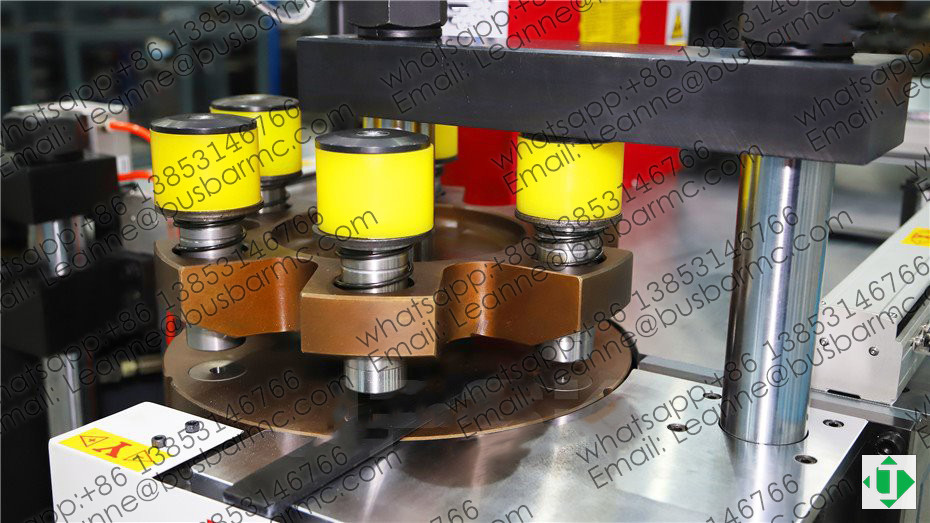
Punching turret unit with multi-station dies (LT / LTMC)
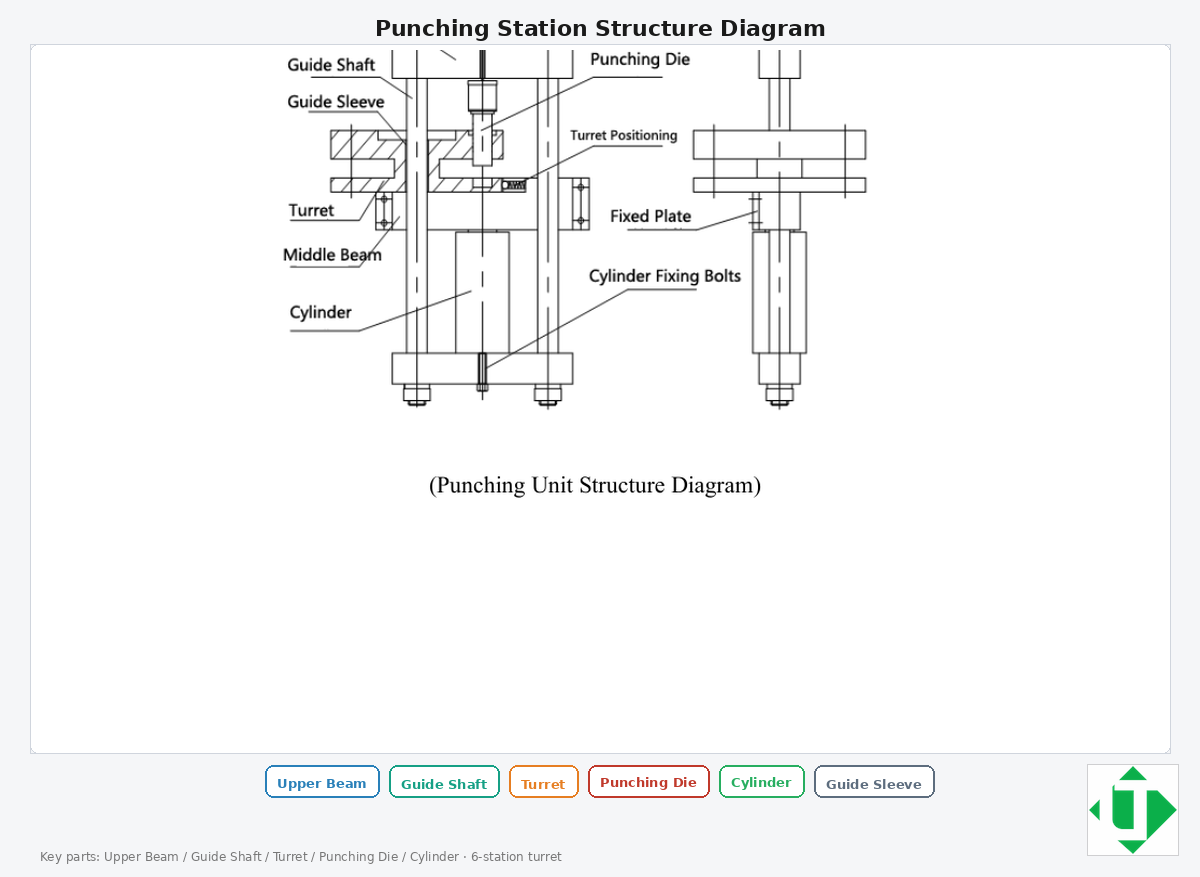
Punching station structure diagram (EN)
Shearing / cutting: blades and hold-down
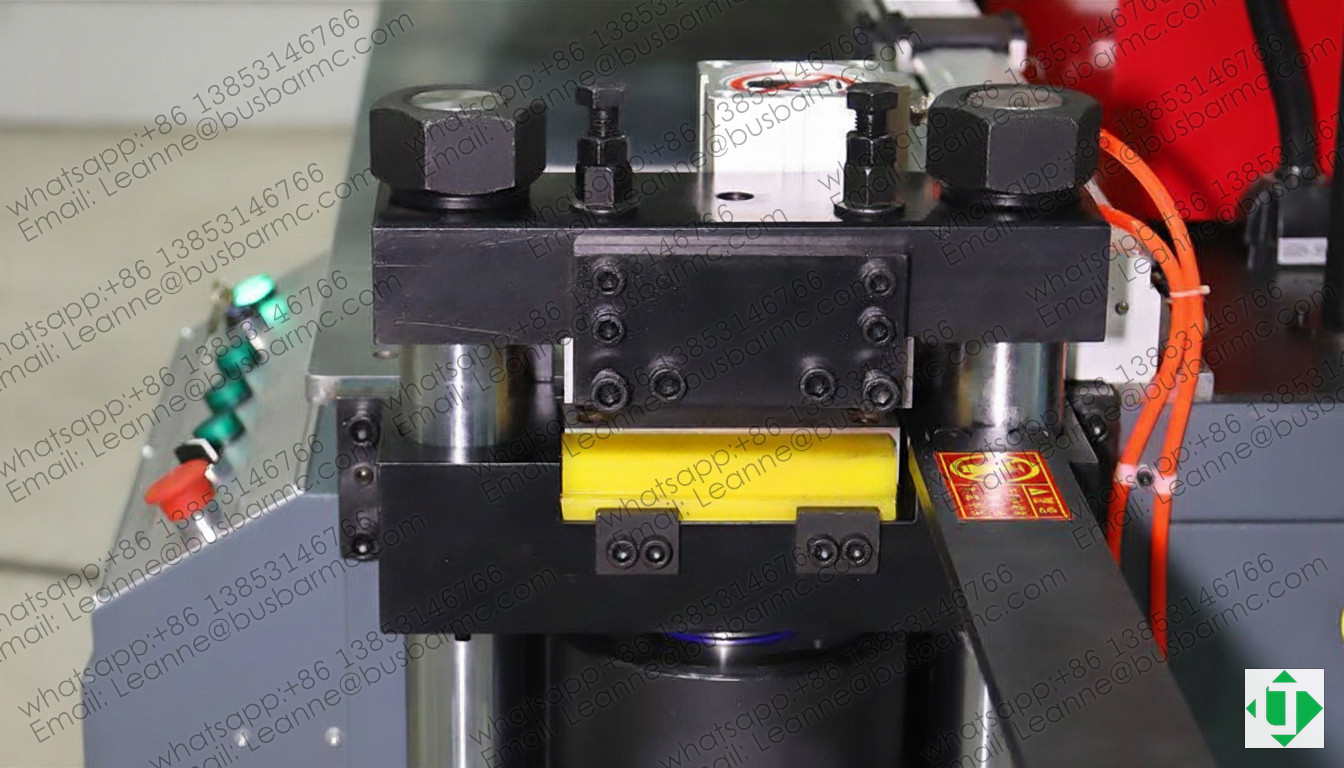
Cutting (shearing) unit close-up (LT / LTMC)
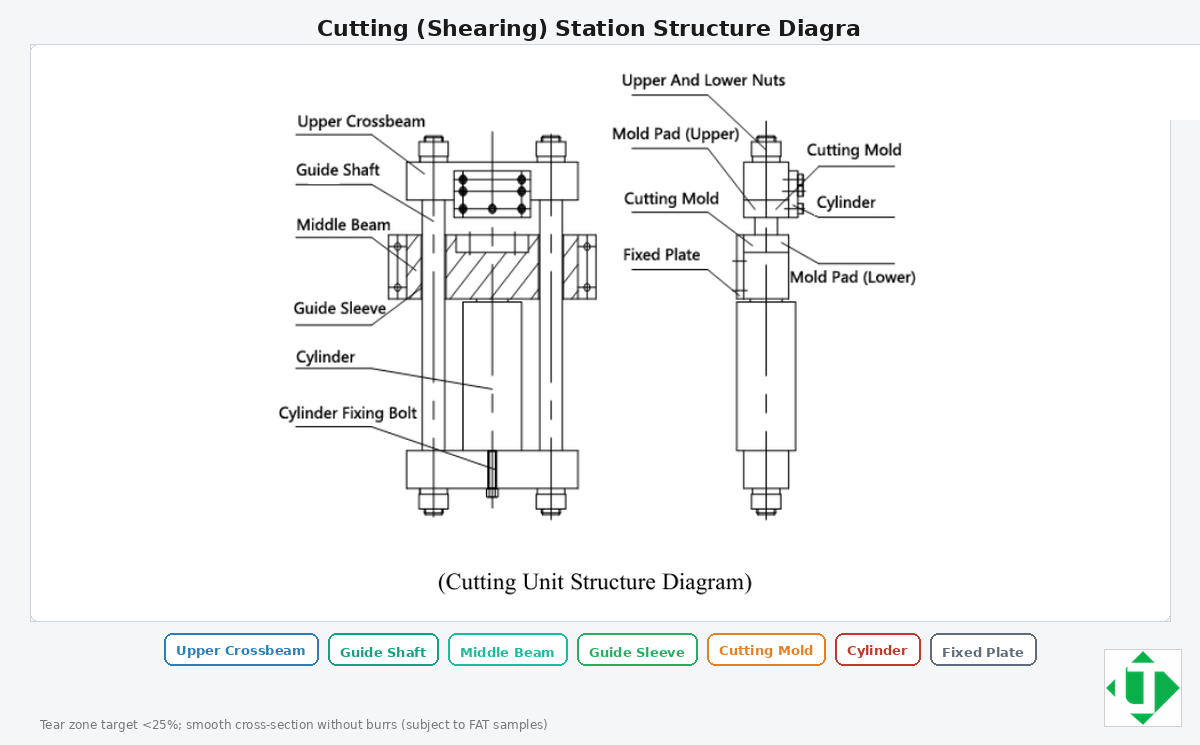
Cutting station structure diagram (EN)
When cutting copper, inspect burrs, end distortion, and blade wear signs.
When cutting aluminium, prioritize clamp pressure and support—excess hold-down can leave marks or change local shape. A worn blade hurts either material.
If cut quality drops after a material change, verify approved blade clearance and clamping before raising hydraulic pressure.
Workshop tear-zone targets often cite under \~25%—treat as a FAT measurement.
Bending: springback tables must stay material-specific
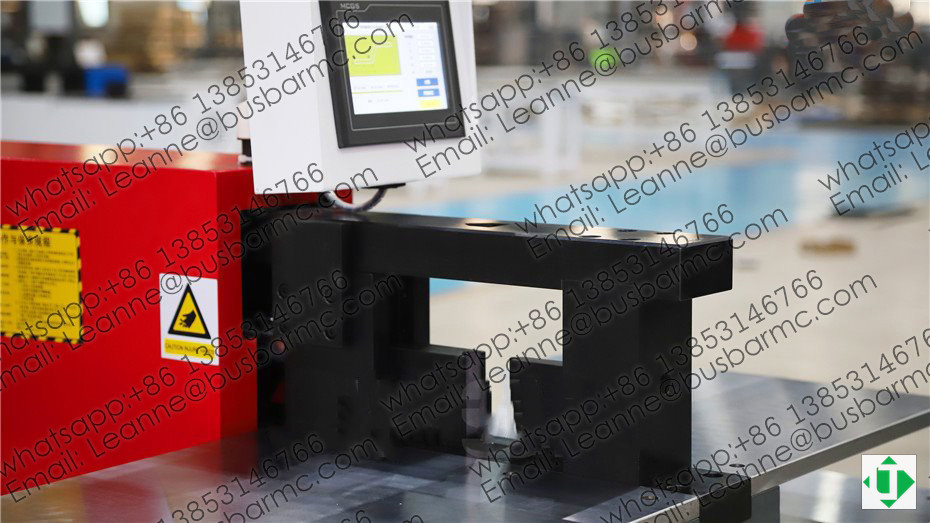
Bending unit with worktable and HMI (LT / LTMC)
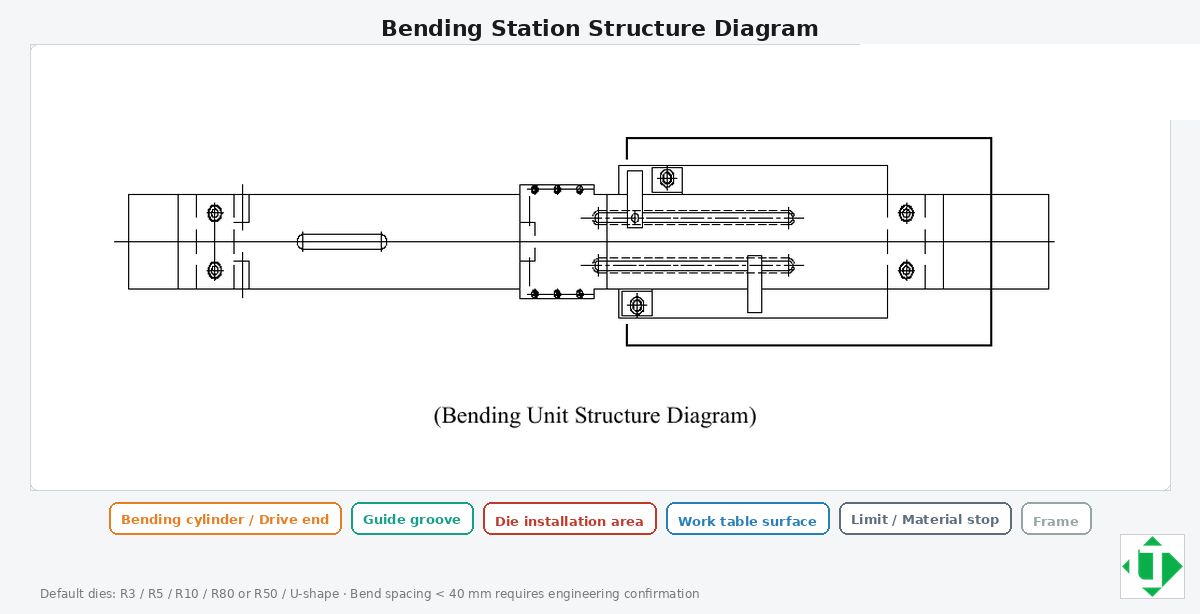
Bending station structure diagram (EN)
- Flat / horizontal and edge / vertical capacities differ; published vertical envelopes are tighter (e.g. 10×100 on 303; 12×120 on 503/803).
- Aluminium usually needs larger springback compensation. Never paste copper HMI recipes onto aluminium without a trial bend.
- Default radii families often include R3 / R5 / R10 / R80 (or R50) plus U-dies—confirm package on order.
Published angle accuracy on product pages: about ±1° with repeat around ±0.5° (OA/FAT).
One machine, two materials — practical rules
- Size the machine by the hardest Cu/Al job (max width×thickness + hardest hole/bend), not the average bar.
- Store Cu recipes and Al recipes separately on the HMI/PLC.
- Change dies/clearance notes when the drawing material changes.
- Run a first-article kit: length, holes, released angle, surface.
- Document FAT samples for both materials if the customer buys dual capability.
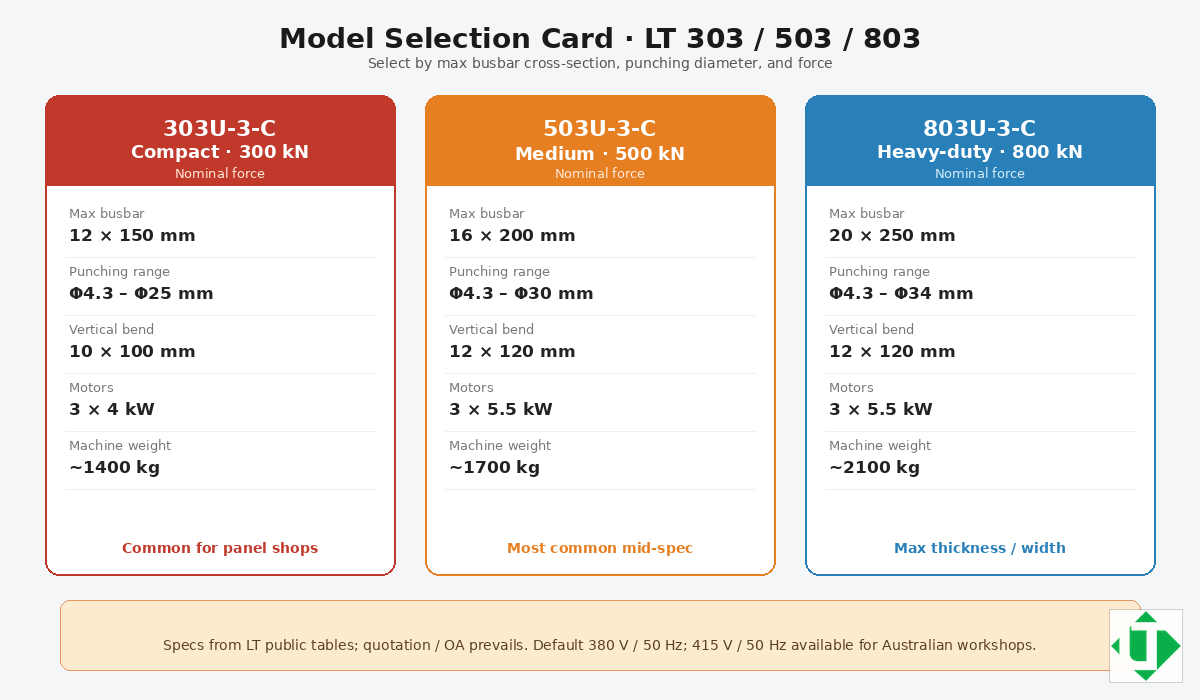
Model selection card: 303U-3-C / 503U-3-C / 803U-3-C
| Entity | 303U-3-C | 503U-3-C | 803U-3-C |
|---|---|---|---|
| Nominal force (kN) | 300 | 500 | 800 |
| Punching diameter (mm) | Φ4.3–Φ25 | Φ4.3–Φ30 | Φ4.3–Φ34 |
| Max thickness / width (mm) | 12 / 150 | 16 / 200 | 20 / 250 |
| Max horizontal bend (mm) | 150 / 12 | 200 / 16 | 250 / 20 |
| Max vertical bend size (mm) | 10×100 | 12×120 | 12×120 |
| Motor power | 3×4 kW | 3×5.5 kW | 3×5.5 kW |
Buyer checklist before RFQ
| Ask / send | Why |
|---|---|
| Cu and/or Al grade + temper | Force, clearance, springback |
| Max width × thickness | Model class 303/503/803 |
| Hole list + oblongs | Punch die package |
| Flat vs edge bends + radii | Bend tooling |
| Surface / film requirements | Clamp pads, handling |
| Dual-material FAT samples | Acceptance proof |
FAQ
Can one busbar machine process both copper and aluminium?
Yes, when capacity, tooling, and settings are approved for each material. Dual capability is not automatic after a copper FAT alone.
Do I need different dies for aluminium?
Often yes for clearance and radius choice. At minimum, keep separate process cards even if the physical die family looks similar.
Why does aluminium bend differently?
Higher elastic recovery (springback) and different minimum inside radius behavior. Measure the released angle, not only the programmed value.
Which LTMC model should I start with?
Map max section and hardest hole/bend to 303 / 503 / 803 using the table above, then confirm on quotation.
Where is public product information?
https://www.busbarcnc.com/ — OA + FAT override public pages when they differ.
Talk to LT about a machine for your Australian workshop
For a quotation, FAT samples, tooling lists or sea freight to Australian ports (Sydney, Melbourne, Brisbane, Fremantle or Adelaide), contact LT at [email protected] or +86 13853146766 (WhatsApp), or use the contact page. Public product information is on busbarcnc.com.
Source and revision
- Prepared for: Australian switchboard builders and panel shops, published on busbarcnc.com
- Brand: LT / LTMC · models 303U-3-C · 503U-3-C · 803U-3-C
- Figures: LT / LTMC workshop photos and English schematics, hosted on this site
- Note: Confirm capacities, dies and voltages on the order acknowledgment and FAT samples. Electrical clearances in the finished assembly follow the switchgear design and AS/NZS 61439, not the machine alone.