 EN
Topic: Switchgear busbar fabrication · equipment configuration · CNC vs 3-in-1
Brand focus: LT / LTMC 303U-3-C · 503U-3-C · 803U-3-C
Audience: Australian switchboard builders and panel shops
Quick answer
Choose busbar fabrication equipment for Australian switchgear and switchboard work from approved drawings, material grade/temper, width×thickness, hole/slot layout, bend geometry, tolerances, batch mix, and conforming output—not nominal force alone. A hydraulic 3-in-1 (LT 303U-3-C / 503U-3-C / 803U-3-C) suits mixed or lower-volume panel shops in cities such as Sydney, Melbourne and Brisbane; servo/CNC positioning helps recurring hole and length kits; dedicated punch–shear lines or bend centres fit high parallel load. Confirm punch, shear, flat bend, and edge bend capacity separately, then prove with samples and FAT. The machine does not set electrical clearances — those come from the switchgear design and AS/NZS 61439 assembly rules.
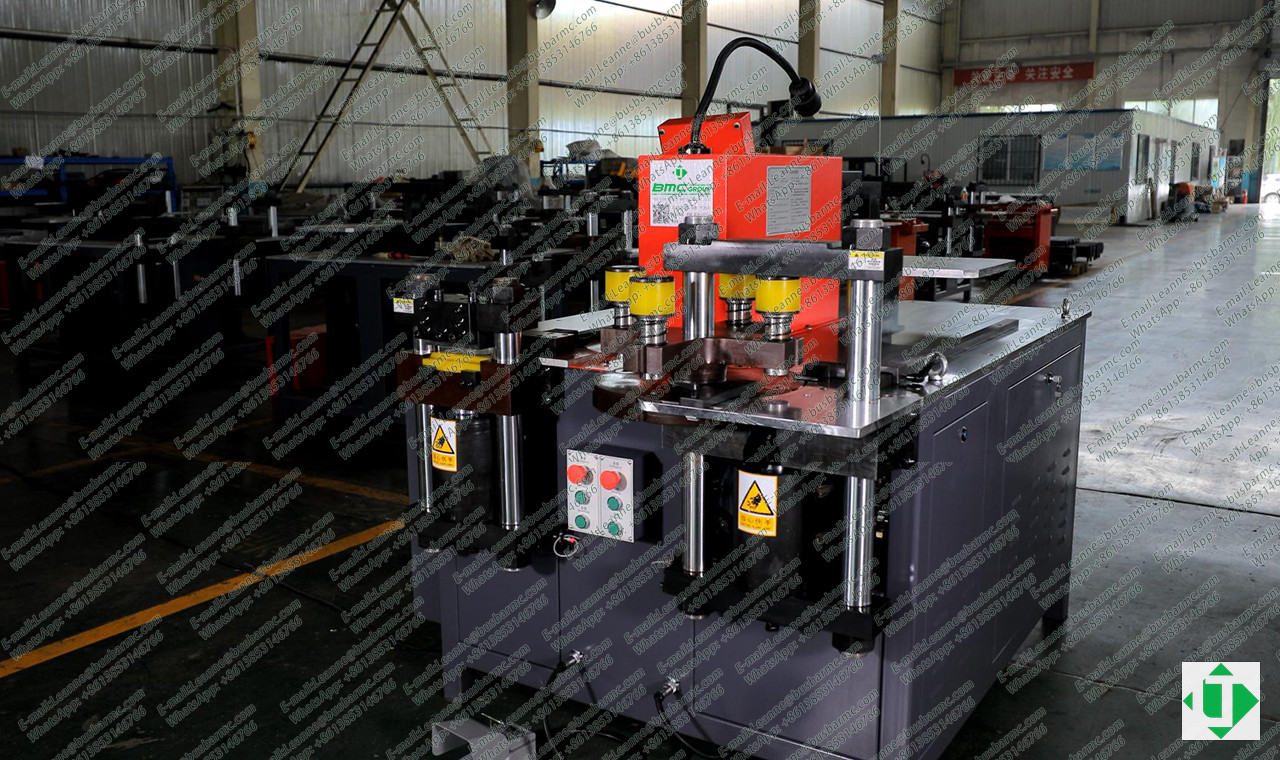
BMC factory view of multi-station busbar machine (LT / LTMC)
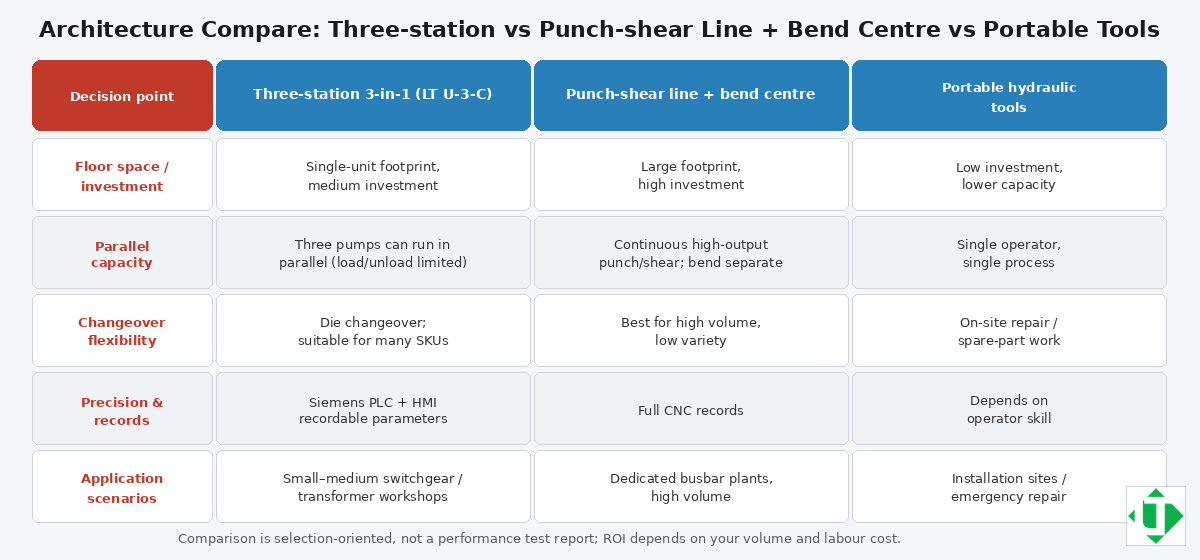
Architecture compare: 3-in-1 vs dedicated vs portable
Operations required for switchgear busbars
| Operation | Finished-part need | Equipment check |
|---|---|---|
| Cut / shear | Length, square, burr | Blade + capacity |
| Punch / slot | Size, pitch, edge distance | Die list + positioning |
| Flat bend | Released angle, radius, short leg | Springback + tooling |
| Edge / vertical bend | Direction + tighter envelope | Separate capacity |
| Complex multi-bend | Assembly envelope | Sequence + interference |
| Mark / deburr / inspect | Traceability + safe edges | Included vs separate |
| Handling | Long/heavy bars | Rollers, crane, staff |
The machine fabricates geometry. It does not by itself set current rating, phase spacing, or clearance rules—those stay with the switchgear design.
Configuration map for switchgear shops
| Production pattern | Starting configuration | Critical buyer check |
|---|---|---|
| Custom panels, lower volume | Hydraulic 3-in-1 or separate hydraulics | Per-station capacity + tooling |
| Mixed recurring models | Servo / HMI recipe 3-in-1 | Program recall + remaining manual steps |
| Repeated holes & fixed lengths | CNC punch–shear line | Feed travel, dead zone, nesting |
| Complex / bottleneck bending | Dedicated programmable bender | Short leg, springback, clearance |
| High parallel workload | Separate punch / cut / bend | Queue time + staffing |
| Wide / thick / long bars | Heavy class + external support | Max-size test on FAT |
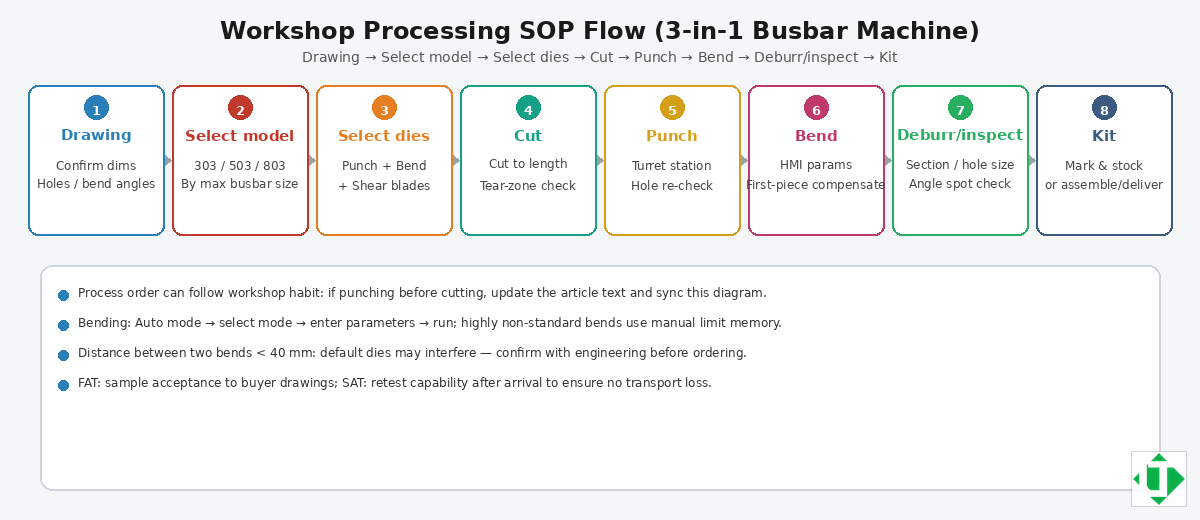
Workshop SOP flow: Drawing → Cut → Punch → Bend → Inspect
Why LTMC 3-in-1 fits many panel builders
One frame hosts punch turret, shear, and bend with three pump groups for sequential or parallel staffing—compact footprint for SME switchgear cells.
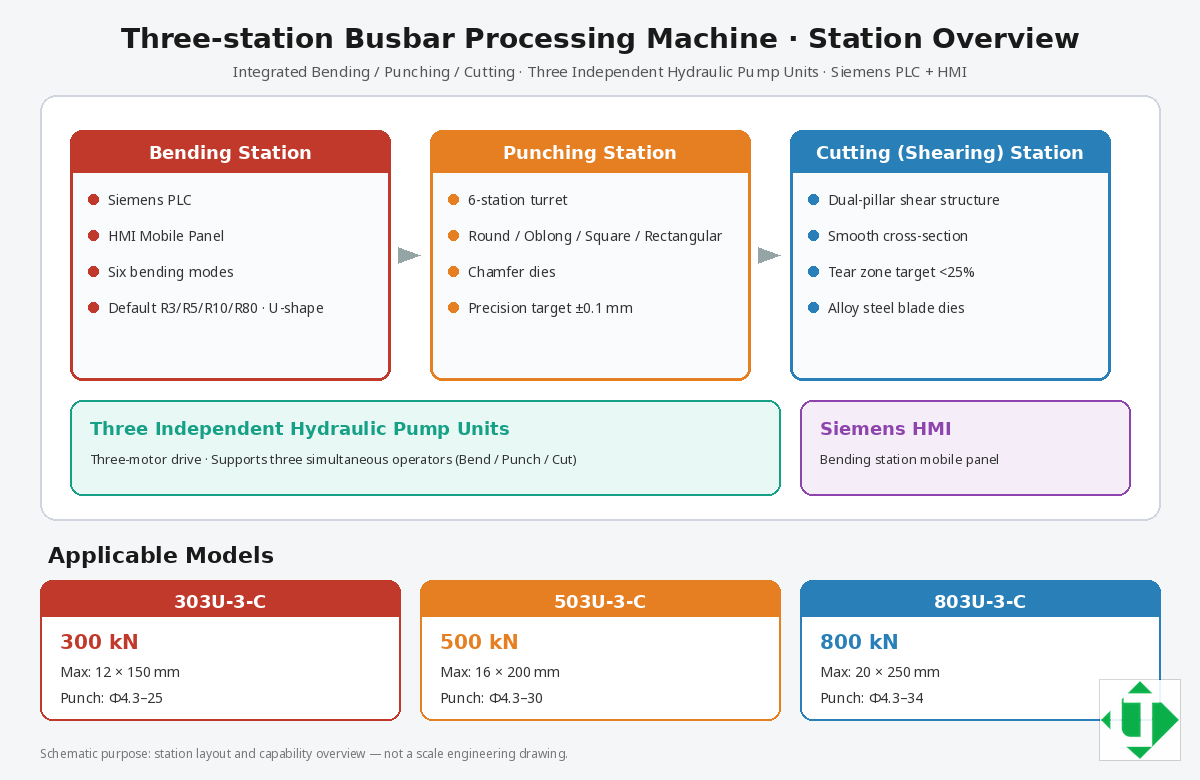
Three-station layout overview with English callouts
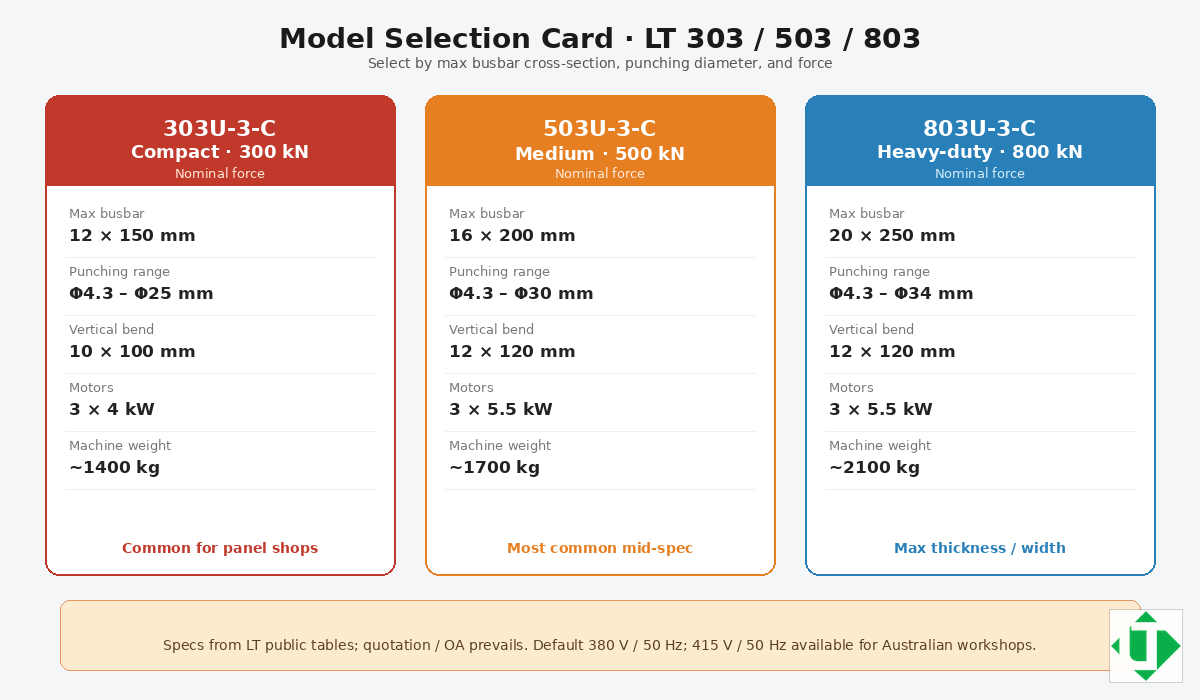
Model selection card: 303U-3-C / 503U-3-C / 803U-3-C
| Entity | 303U-3-C | 503U-3-C | 803U-3-C |
|---|---|---|---|
| Nominal force (kN) | 300 | 500 | 800 |
| Punching diameter (mm) | Φ4.3–Φ25 | Φ4.3–Φ30 | Φ4.3–Φ34 |
| Max thickness / width (mm) | 12 / 150 | 16 / 200 | 20 / 250 |
| Max horizontal bend (mm) | 150 / 12 | 200 / 16 | 250 / 20 |
| Max vertical bend size (mm) | 10×100 | 12×120 | 12×120 |
| Motor power | 3×4 kW | 3×5.5 kW | 3×5.5 kW |
Selection & FAT for switchgear RFQs
- Send representative cabinet busbar drawings (holes, bends, lengths).
- State Cu/Al, temper, max section, monthly mix.
- List must-hit tolerances and inspection instruments.
- Agree FAT sample set (first / middle / last of a short run).
- Confirm voltage (often 380 V/50 Hz, with 415 V/50 Hz available for Australian workshops) and HMI language.
FAQ
What equipment does switchgear busbar work need?
Typically cut, punch, bend, deburr, mark, and inspect—plus handling for long bars.
Is a 3-in-1 enough for switchgear?
Often yes for mixed SME work. Scale to dedicated or CNC lines when volume or parallel load outgrows one frame.
Flat vs edge bend in cabinets?
Both appear in switchgear. Edge/vertical capacity is usually tighter—verify separately.
Does the machine set electrical clearances?
No. It produces mechanical geometry; electrical design stays with the approved arrangement.
Talk to LT about a machine for your Australian workshop
For a quotation, FAT samples, tooling lists or sea freight to Australian ports (Sydney, Melbourne, Brisbane, Fremantle or Adelaide), contact LT at [email protected] or +86 13853146766 (WhatsApp), or use the contact page. Public product information is on busbarcnc.com.
Source and revision
- Prepared for: Australian switchboard builders and panel shops, published on busbarcnc.com
- Brand: LT / LTMC · models 303U-3-C · 503U-3-C · 803U-3-C
- Figures: LT / LTMC workshop photos and English schematics, hosted on this site
- Note: Confirm capacities, dies and voltages on the order acknowledgment and FAT samples. Electrical clearances in the finished assembly follow the switchgear design and AS/NZS 61439, not the machine alone.