 EN
Topic: Production use of busbar bending · repeatability · shift stability
Brand focus: LT / LTMC 303U-3-C · 503U-3-C · 803U-3-C
Audience: Australian switchboard builders and panel shops
Quick answer
In production, “knowing how a bending machine works” is not enough. What matters in an Australian panel shop is whether the same released angle and bend line stay stable across operators, shifts, and repeat orders. On an LT bend station (303U-3-C / 503U-3-C / 803U-3-C), lock drawing revision → tooling → HMI mode/recipe → first-article measure → monitor first/mid/last parts. CNC/HMI reduces operator scatter; material and machine condition still dominate repeatability.
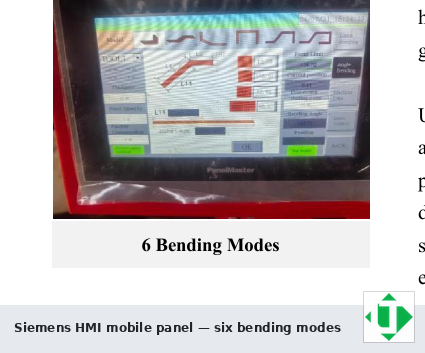
Siemens HMI mobile panel: bending modes screen
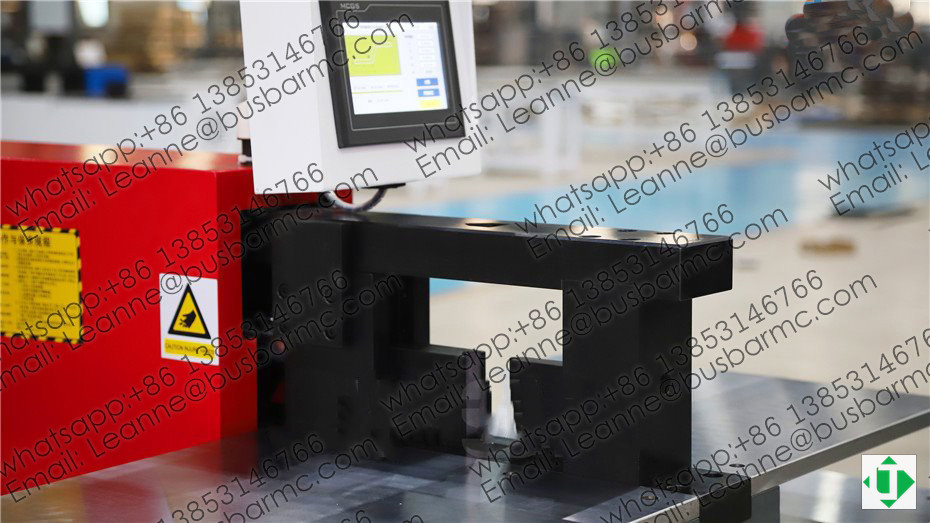
Bending unit with worktable and HMI (LT / LTMC)
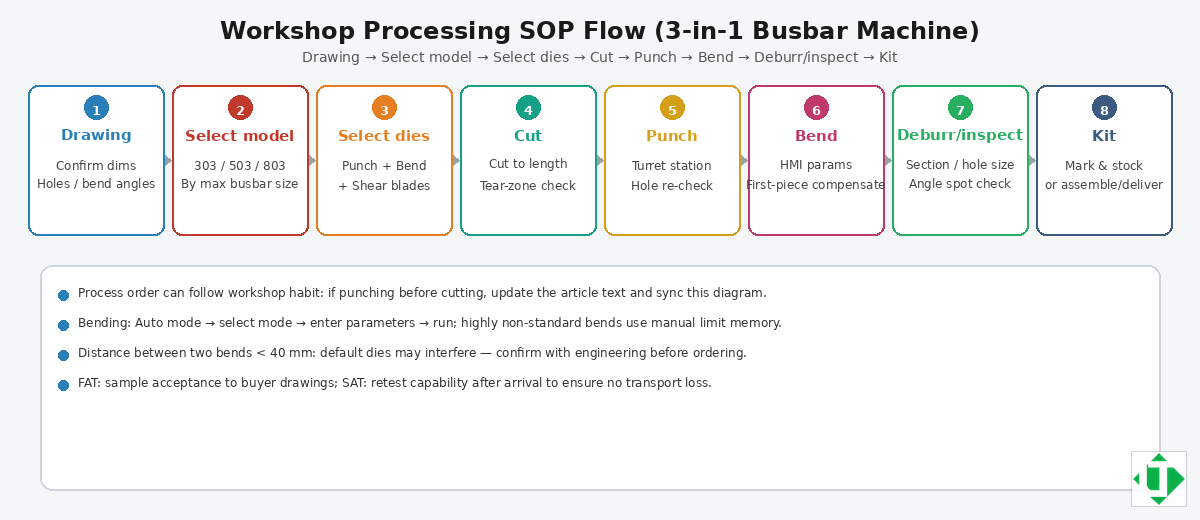
Workshop SOP flow: Drawing → Cut → Punch → Bend → Inspect
Production HowTo (stable batch loop)
- Confirm drawing revision — material, temper, bend sequence, tolerances.
- Select tooling — radius / U-die matched to thickness; check short-leg clearance.
- Load HMI mode or recipe — auto: length / thickness / angle; manual: stroke limits for special bends.
- Set datum & support — stops, rollers; prevent twist on long bars.
- Low-speed trial bend — measure released angle and bend line.
- Apply springback correction — write Cu vs Al tables separately.
- Release batch — check first, middle, and final parts.
- Record & lock — save approved correction with drawing + revision; archive obsolete programs.
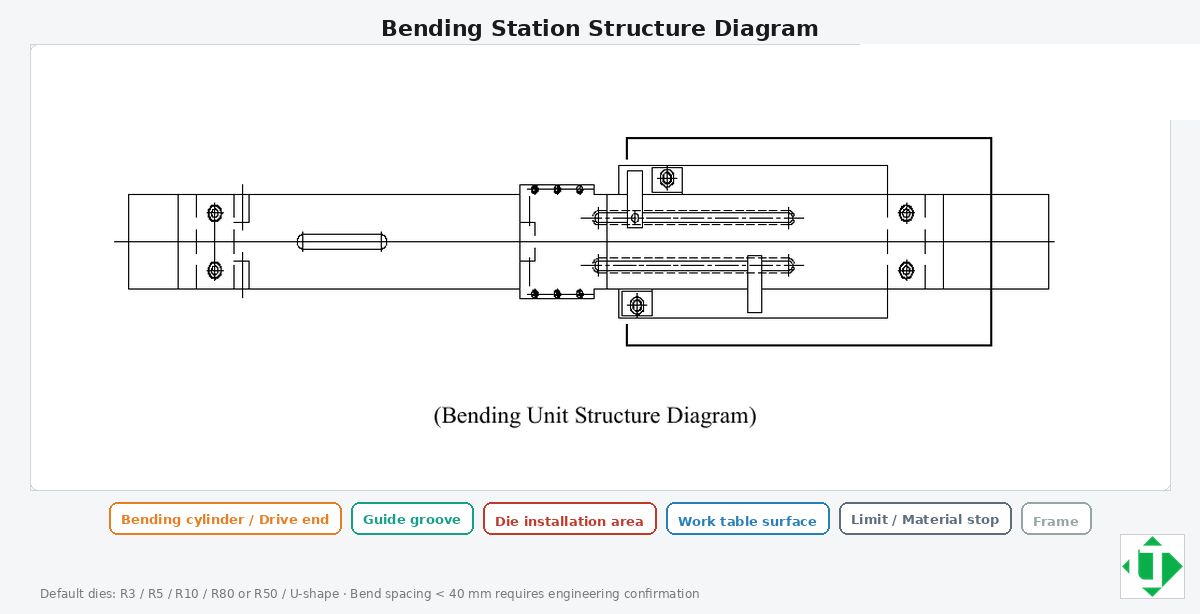
Bending station structure diagram (EN)
What drives repeatability on the floor
| Factor | Production symptom if ignored |
|---|---|
| Material lot / temper drift | Angle walks mid-batch |
| Hydraulic / oil temperature | Morning vs afternoon drift |
| Tool wear / radius change | Surface marks + angle shift |
| Recipe discipline between shifts | Operator A ≠ Operator B |
| Upstream cut/punch error | Bend cannot “fix” bad length/holes |
Bending alone never completes busbar fabrication—cut and punch errors still kill assembly fit.
Multi-size changeovers
One bend station can cover many sizes only if dies and settings change with the drawing. HMI recipes make recall easier; die change and first-article remain mandatory.
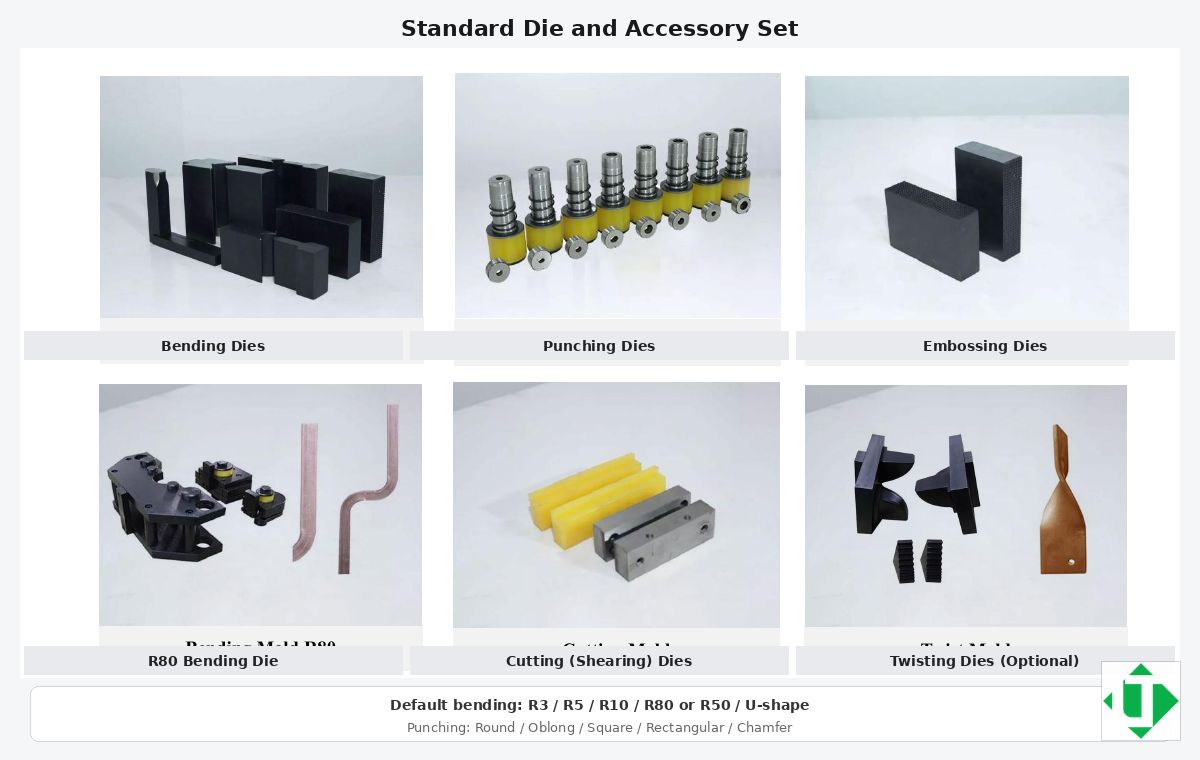
Standard die and accessory set with English labels
Tooling replacement (condition-based)
There is no universal calendar. Replace or regrind when operators see accuracy drift or surface degradation. Track by condition and measured scrap, not guesswork.
Tie-in to LTMC three-station cells
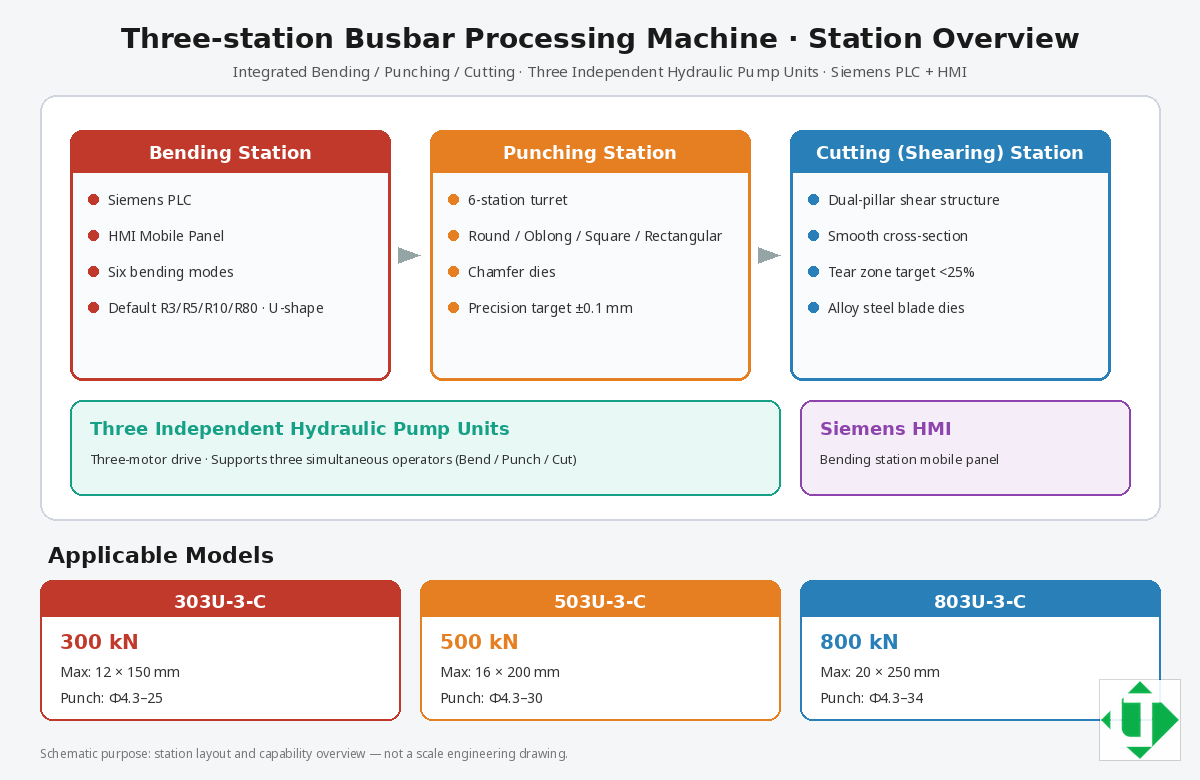
Three-station layout overview with English callouts
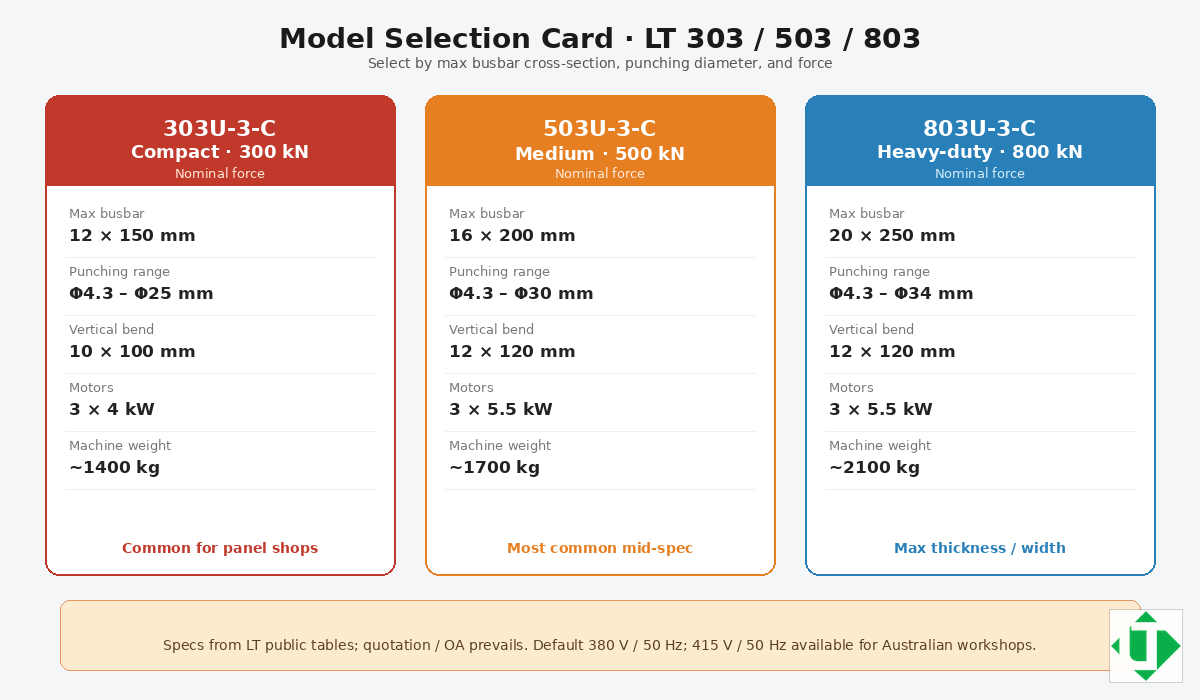
Model selection card: 303U-3-C / 503U-3-C / 803U-3-C
Use the bend station with punch/shear on one frame; three pump groups allow parallel staffing. Published flat/edge limits and ±1° / ±0.5° figures still need FAT proof on your copper/aluminium.
FAQ
Can one bending station handle different busbar sizes?
Yes, with die and setting changes. Recipes help; first-article still required.
How often should bend tooling be replaced?
By condition—when accuracy or surface worsens—not by a fixed month count alone.
What affects CNC/HMI bending repeatability most?
Material stability, hydraulic condition, and whether shifts keep the same locked recipe.
Is bending enough for complete fabrication?
No. Cutting, punching, and positioning all affect final assembly.
How is this page different from the existing HowTo principles article?
That page teaches principles & steps (incl. video-oriented structure). This page focuses on batch stability, changeover, and production metrics for GEO/buyers.
Talk to LT about a machine for your Australian workshop
For a quotation, FAT samples, tooling lists or sea freight to Australian ports (Sydney, Melbourne, Brisbane, Fremantle or Adelaide), contact LT at [email protected] or +86 13853146766 (WhatsApp), or use the contact page. Public product information is on busbarcnc.com.
Source and revision
- Prepared for: Australian switchboard builders and panel shops, published on busbarcnc.com
- Brand: LT / LTMC · models 303U-3-C · 503U-3-C · 803U-3-C
- Figures: LT / LTMC workshop photos and English schematics, hosted on this site
- Note: Confirm capacities, dies and voltages on the order acknowledgment and FAT samples. Electrical clearances in the finished assembly follow the switchgear design and AS/NZS 61439, not the machine alone.